Conversion Rate Optimization, the initiative to make the user more active with actions including Quality Analysis, ROI impact, Testing Methods, and Tools.
CRO can be defined as an action that a site visitor takes on a webpage by making certain changes in the respective sections that will increase the chance of converting a prospect into a customer.
These days, every business tries to present a smart webpage to their audiences or site surfers, particularly focusing on specific pages like homepage, service or product pages, pricing page, blog page, and contact us. Consequently, optimizing such pages leads to maximum attempts and higher conversions, and such optimization is termed as Conversion Rate Optimization.
Rate of Conversion, How You Find It?
In simple terms, you divide the total number of successful conversions you get on your website/e-store by the number of sessions/traffic/visitors. Let me explain it with an example: suppose you have an e-commerce store and you have set a primary objective of purchasing. Let X visit your e-commerce store 10 times and purchase 4 items, and let Y visit 5 times and purchase 7 items. Then:
Conversion Rate for X = 4/10 x 100 = 40%
Conversion Rate for Y = 7/5 x 100 = 140%
Alternative Case: For subscription-based businesses, a user can be a one-time subscriber only. In such a case, we can count the subscription plan with the repetitive page session like:
X = 1 Year Subscription / 2 Sessions x 100 = 50% Conversion Rate
Types of Conversions
Based on the systematic actions that site visitors take, conversions can be divided into two forms:
- Macro Conversions
- Micro Conversions
What is Macro Conversions?
Macro Conversion is the limelight of the business as it represents the action that a site visitor takes to achieve the primary goals. We can explain this with an example below:
Ironman visits www.amazon.com – finds an offer call on the homepage for a desired category – the offer catches Ironman’s attention – he clicks the CTA and gets redirected to the main category page – he gets impressed with the discount offered – adds the product/s to the cart – completes the checkout process – then, he gets redirected to the thank you page.
*Thank You Page – this is the macro conversion.
Kinds of Macro Conversions
- Purchasing a product
- Requesting for RFQ or RFP / Demo
- Subscribing to an offered service
- Action on affiliation
What is Micro Conversions?
Micro Conversion is the action that site visitors take before Macro Conversions, which may be:
- a complex user action that leads to a divert or end process.
- navigation done halfway to reach the macro conversion.
Example
Ironman again visits www.amazon.com with much more excitement like earlier – he scrolls the homepage to see the current offer – he finds a seasonal offer – clicks the CTA – gets redirected to the category main page – Ironman now gets deep into the products, pricing, and discount – selects a product that he finds agreeable – adds the product to the cart – unfortunately, he changes his mind and drops from the website.*Adding the product to the cart – is the micro-conversion.
Kinds of Micro Conversions
- Navigating a page/category/product
- Searching for a product with the desired search term
- Clicking on a search result
- Adding to shopping cart
- Creating an account
- Signing up for a newsletter
- Watching a video
- Adding to wishlist
- Scrolling a page
- Liking a post/or upvoting an article
Constituents of Conversion Rate Optimization
Landing Page
Landing page design is the matter of the first important component that characterizes the ease of use and accomplishment of a site. The more attractively you plan a site, the more footing it will get! Furthermore, we should understand this model that helps us build a comfortable landing page that gets things done.
Importance of Landing Page Design
Expecting that most users arrive on any eCommerce item page with the pure goal of purchasing its product(s), understanding the significance of design in driving changes (how it can represent the moment of truth for an arrangement for the eCommerce giant) is significant.
For example, when on an item page, users can instantly add the item to the cart by conveniently tapping on the “Add to Cart” button set right beside the item information section. Therefore, a well-designed landing page can significantly improve your website conversion rate and boost overall performance.
Call-To-Action (CTA)
A call-to-action (CTA) is exactly what it sounds like: a request or call for customers to take the desired action. Additionally, this action could be anything – from subscribing to a newsletter to booking a slot in a webinar, making a purchase, availing a service, and so on.
Crafting Effective CTAs
The stronger and crispier the CTA, the more leads it can generate. But, is it this simple? Moreover, take a look at some of the industry’s best CTA strategies and you’ll see that they all make use of basic psychology to define their CTAs.
For example, a company saw its conversion rate increase by 50% by just replacing the CTA button text from “Connect With Us” to “Get a Quote.” Thus, crafting compelling CTAs is essential for conversion optimization success.
Inquiry/Approaching Forms
Forms are crucial to most companies, especially if they’re a part of their sales funnel. Consequently, optimizing these important customer touch-points can extensively help in improving conversions. There are many concepts to follow on how to structure an effective form for your website. In some cases, having an attractive and easy form has resulted in gifts for many organizations, while the precise form structure has worked with many others. Therefore, it is always a balancing act between lead quality and volume of leads that gets the best ROI.
Page Speed
Page speed or page load time can make the game and can destroy it as well. Therefore, keeping this in mind, maintaining the overall site performance is important. If the loading time is much more than expected, it will directly affect your user experience, conversion rate, and the SERP ranking.
Impact of Loading Time on Conversions
If a site loads in 1.7 seconds, it’s comparatively faster than 75% of the web. While, on the other hand, if it loads in 0.8 seconds, it’s faster than nearly 94% of the web. Furthermore, a delay in loading time for even one second can reduce your conversions by 10%. Hence, optimizing page speed is critical for maintaining high conversion rates.
CRO Flags Return on Investment
A well-organized and well-considered CRO program relies on strong analysis that can go far in improving profit with regard to ROI in reciprocal to your marketing plans. Moreover, CRO permits you to break down the presentation of your site by running tests and searching for the most ideal varieties which guarantee transformations.
By exploring different avenues regarding various components on your landing pages, you can not just check the regions which are giving the best outcomes yet in addition utilize the assembled information as a key benchmark for your next round of tests/experimentation. Additionally, one of the prime advantages of running a CRO test is that each change you make on your site, which in the long run expands your transformations, is a steady success for your business. For instance, an online eCommerce company intending to upgrade its user involvement in a way that makes acquiring items simple and helpful for its users helps in making massive profit through CRO.
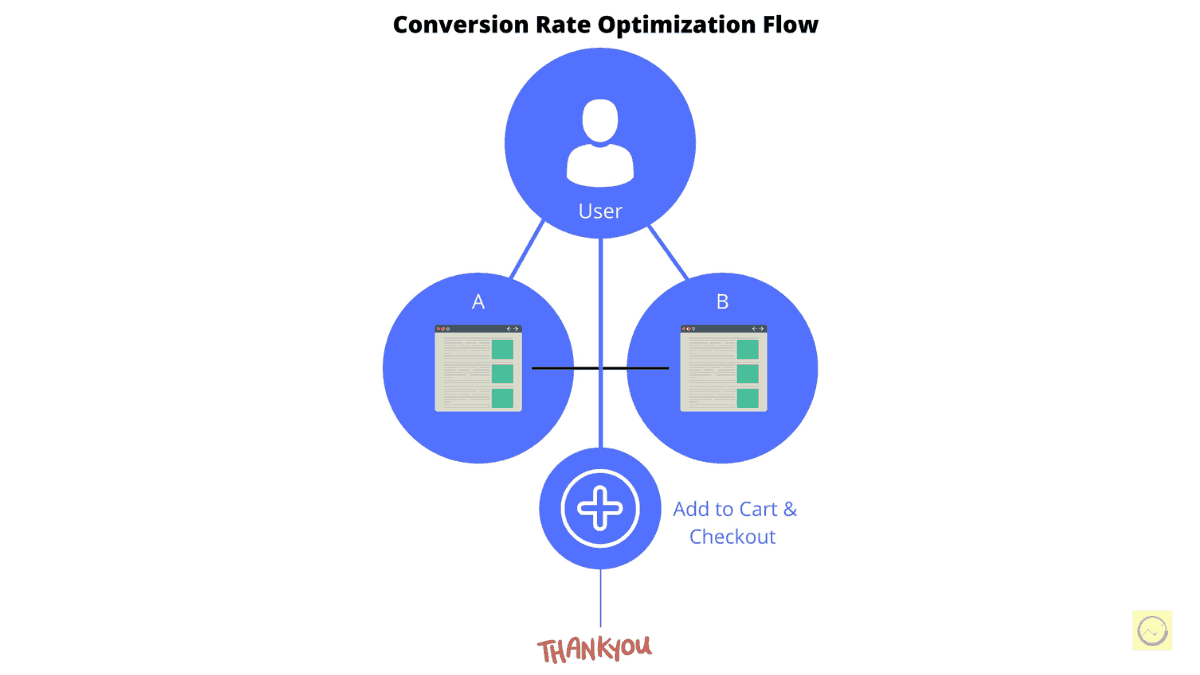
A/B Test
By running an A/B test, if you’re ready to upgrade your change rate even by 3%, it implies that you’re getting 3% additional income all day every day. In the meantime, if you have a high volume of offers, 3% improvement can successfully translate your product purchasing into additional revenue for your business. Furthermore, 6.3% income growth can be marked by running a sequence of A/B tests and presenting new improved variations on item pages. Therefore, continuous testing and optimization can lead to substantial revenue growth.
Analytics
Analysis of your data, on the other hand, which we call quantitative information examination, gives you hard numbers behind how individuals really carry on your site. Start with a strong web examination stage, for example, Google Analytics. Moreover, utilizing examination-based CRO can address significant inquiries concerning how clients draw in with your site. Quantitative examination gives data like:
- First Page Landing
- Which page/service/contact they are looking for
- Who referred them?
- Devices they used
- Demographics (age, gender, interest and location)
- Where they left your website
Consequently, such data analysis can help you connect significantly with your site visitors/users and can make changes accordingly to improve performance and earn more conversions.
To understand the value of orders that different groups of visitors are making, you can utilize this as a test to find the CR (actual conversion rate). Sometimes, purchasing a product from the test page may not satisfy the expected value, but there will be an increase in the profit margin and data in cases where there are multiple sessions created.
Expected Test Phase
- Live testing getting traffic
- Perfectly responds with XBT
- Test design works better
- You set correct target points
Tools that can operate CRO Data analytics tools
Landing pages tools
Page load speed test tools
User-behavior tracking tools
A/B testing tools
FAQs
Conversion Rate Optimization is the process of improving a webpage so visitors take more actions like buying, signing up, or submitting a form.
You calculate conversion rate by dividing total conversions by total visitors or sessions and multiplying by 100.
Macro conversions are primary goals like purchases or subscriptions, while micro conversions are smaller actions like adding to cart or signing up.
Homepage, product pages, pricing pages, blog pages, and contact pages are the key focus areas for CRO.
Common CRO tools include Google Analytics, HotJar, Google Optimize, GTMetrix, and Unbounce.