Something subtle has shifted inside Meta Ads, and most B2B teams are still catching up.
On the surface, the dashboards look familiar. Spend goes out. Impressions come in. Leads trickle through. Yet behind the scenes, the system is making stronger decisions about who actually deserves your budget.
I’ve been watching this play out across B2B accounts where performance didn’t collapse overnight but slowly drifted. Costs crept up. Lead quality felt inconsistent. Sales teams pushed back. What kept showing up wasn’t creative fatigue or bidding issues. It was filters. Not as a checkbox setting, but as the mechanism quietly steering the entire funnel.
This matters because B2B buying cycles are long, attention is expensive, and wasted impressions rarely look like mistakes until months later.
What Changed in Meta Ads Targeting
Meta didn’t announce a major overhaul, but the delivery logic has clearly evolved.
Targeting has moved away from surface level interests and toward behavior driven signals that reflect how people actually research and evaluate. Filters now influence delivery well beyond awareness. They affect who keeps seeing your ads, who drops out, and who moves deeper into the funnel.
Instead of rewarding raw reach, the system increasingly rewards relevance and timing.
For B2B brands, this changes the math. You’re no longer paying to educate everyone who might be curious. You’re paying to stay present with people already showing signs of intent.
Why This Shift Matters for B2B Funnels
B2B funnels often look healthy at the top and broken at the bottom.
Traffic is there. Engagement looks fine. Yet sales momentum stalls. Behavioral filters help explain why.
They align delivery with how buyers actually behave. People research, pause, compare, disappear, and return. Filters help Meta recognize those patterns instead of treating every impression as equal.
I’ve seen campaigns stabilize simply by removing early stage noise. Cost per lead improves, but more importantly, lead quality stops feeling random.
The Filters Acting as Gatekeepers
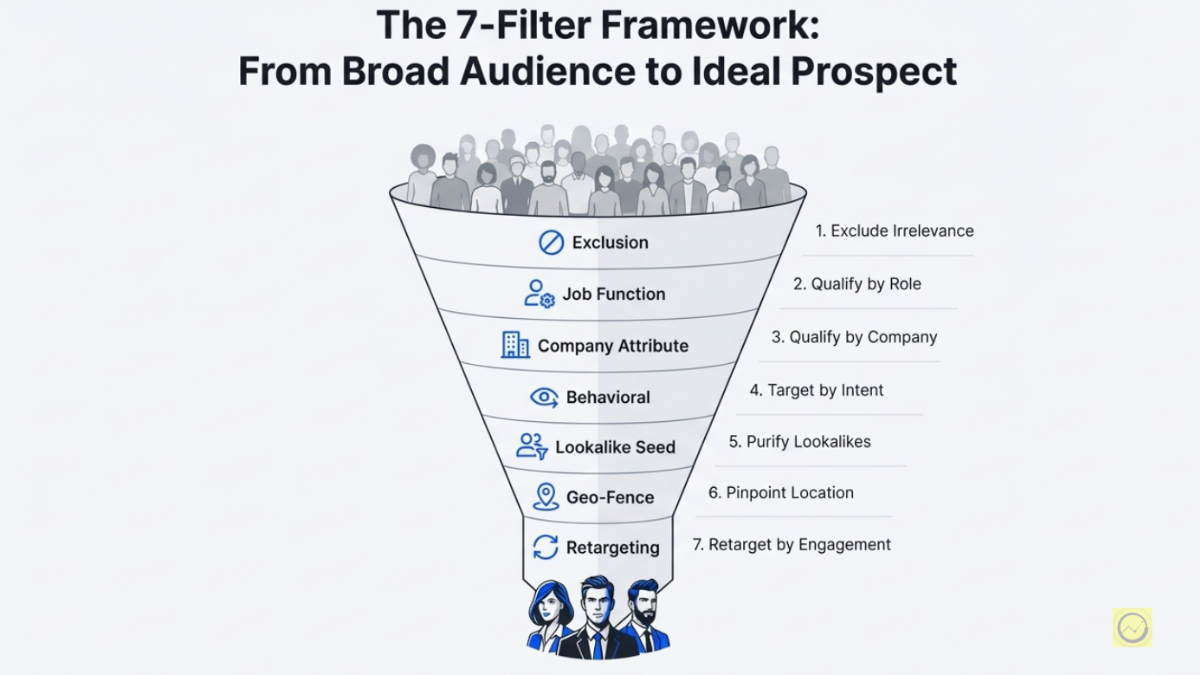
These seven filters are not isolated tactics. Together, they act like gates between stages of the funnel.
Each one decides who moves forward and who quietly falls away.
Think of it this way. Awareness attracts attention. Filters decide who earns the right to see the next message.
1. Engagement Depth Filter
This filter prioritizes users who do more than scroll past an ad. Watching a video past the halfway point, swiping through a carousel, or saving content signals real attention.
In B2B software and services, advertisers often see fewer wasted impressions once delivery favors people who engage deeply instead of those who register a three second view.
Industry benchmarks consistently show that users with higher engagement depth are two to three times more likely to complete a form later in the funnel.
2. Funnel Recency Filter
Recency separates active consideration from forgotten curiosity. Someone who engaged last week behaves very differently from someone who clicked months ago.
In longer sales cycles like enterprise SaaS, teams often focus spend on recent webinar viewers or page visitors while excluding older engagement that never progressed.
Across B2B accounts, recency based audiences frequently deliver lower cost per lead simply because intent fades faster than most teams expect.
3. Content Interaction Filter
Meta tracks how users interact with different content types. Case studies, comparison pages, and webinar views act as early signals that evaluation has started.
In industries like cloud services or consulting, teams often shift budget toward users engaging with mid funnel content instead of continuing broad education. These audiences tend to convert at higher rates because the groundwork is already done.
4. Device and Platform Behavior Filter
Not all devices signal the same intent. Desktop usage often reflects research and comparison, while mobile leans toward discovery.
Many B2B advertisers limit complex lead forms and detailed offers to desktop placements while using mobile for early stage awareness. Desktop focused campaigns regularly show stronger completion rates for longer forms.
5. Frequency Control Filter
Frequency is a quiet trust killer in B2B. Decision makers notice repetition quickly, especially in smaller buying committees.
Tighter frequency control helps maintain visibility without fatigue. While higher frequency can accelerate decisions in some scenarios, uncontrolled repetition often drives costs up without moving deals forward.
6. Lookalike Quality Filter
Not all lookalikes perform equally. Smaller, high quality seed lists routinely outperform larger, noisier ones.
CRM based seeds tied to real pipeline activity now outperform pixel only audiences in many B2B accounts. Meta’s delivery engine increasingly favors signal quality over raw volume.
7. Conversion Stage Filter
Clear separation between funnel stages improves learning and delivery. One campaign per stage consistently outperforms blended objectives. In complex buying environments, this prevents early stage audiences from being overwhelmed with demos or pricing before they are ready.
What Marketers Should Pay Attention To Next
Most B2B teams still spend more time adjusting creatives than examining filters. A simple audit often reveals overlapping audiences, outdated recency windows, or blended objectives working against each other.
Small structural changes upstream tend to stabilize performance downstream. Results don’t appear overnight. They compound over weeks as the system learns who truly belongs in each stage.
Industry Reaction
Growth teams are gradually reallocating spend back toward Meta after seeing more predictable lead quality. Agencies report fewer delivery spikes and smoother scaling once filters are treated as strategy, not settings.
Going Forward A B2B Marketer/Owner Should Remeber
Meta Ads still work for B2B, but the center of gravity has shifted.
Filters now do the heavy lifting. They don’t guarantee wins, but they remove much of the waste that quietly erodes performance.
This approach won’t fit every account, but it reflects how the platform prioritizes intent over reach. When metrics feel unstable, the problem usually starts well before bids or creatives.
FAQs
Behavioral targeting focuses on how users interact with content, ads, and platforms rather than basic demographics. In B2B, this includes engagement depth, recency, and content interaction signals.
Interests capture curiosity. Filters capture intent. B2B buying decisions rely more on behavior than declared preferences.
Yes. Many B2B advertisers improve lead quality by reallocating spend toward higher intent filtered audiences instead of increasing overall spend.
Engagement depth, recency, content interaction, and conversion stage filters tend to have the biggest impact.
Most filters require a learning period of two to four weeks before performance stabilizes.
Yes. Even at the awareness stage, filters help signal which users should continue seeing your brand.
No. Filters and creative work together. Filters decide who sees the message. Creative determines whether the message resonates.